
Collaborating with the Spirit
by Jyoti Sarkar
Let me paraphrase from the Kid’s Study Bible (New International Reader’s Version), John 21:3-6.
Peter, Thomas, Nathanael and the sons of Zebedee went out and got into the boat. That night they did not catch anything. Early in the morning Jesus stood on the shore. But the disciples did not realize that it was Jesus.
He called out to them, “Friends, don’t you have any fish?” “No,” they answered. He said, “Throw your net to the right side of the boat. There you will find some fish.” When they did, they could not pull the net into the boat. There were many big fish in it.
I cannot swim; I cannot row a boat; I cannot steer a ship. Yet I, too, am a fisherman. I catch fish — small, medium, large; all alone, or in teams of two, three, or four. During the last ten years, I have caught 8-10 fish per year.
“With such a dismal record as a fisherman, how can you make a living?” you may wonder.
I am glad you asked. “For me, fishing is more than a living. It is my life. You see, I am a mathematician. Every paper I published is like a new fish I have caught.”
I do what I am trained to do, just as you do what you are called to do. I am thankful the sea I fish from will never run out of fish. Whenever I am ready, I can return to it with a curious mind and look around for a fresh catch. And I am always looking forward to fishing together with other fishermen. Who knows, I may not be able to pull the net into the boat alone!
Today, I will tell you the story of a catch that I did not plan, that I could not dream of, and that I cannot take much credit for. It happened during the four weeks between November 11 and December 09, 2024. When I heard, “Throw your net to the right side of the boat,” I groaned, “I am tired from the last catch. I need to rest for a few days. But since you are saying so, I will cast my net.”
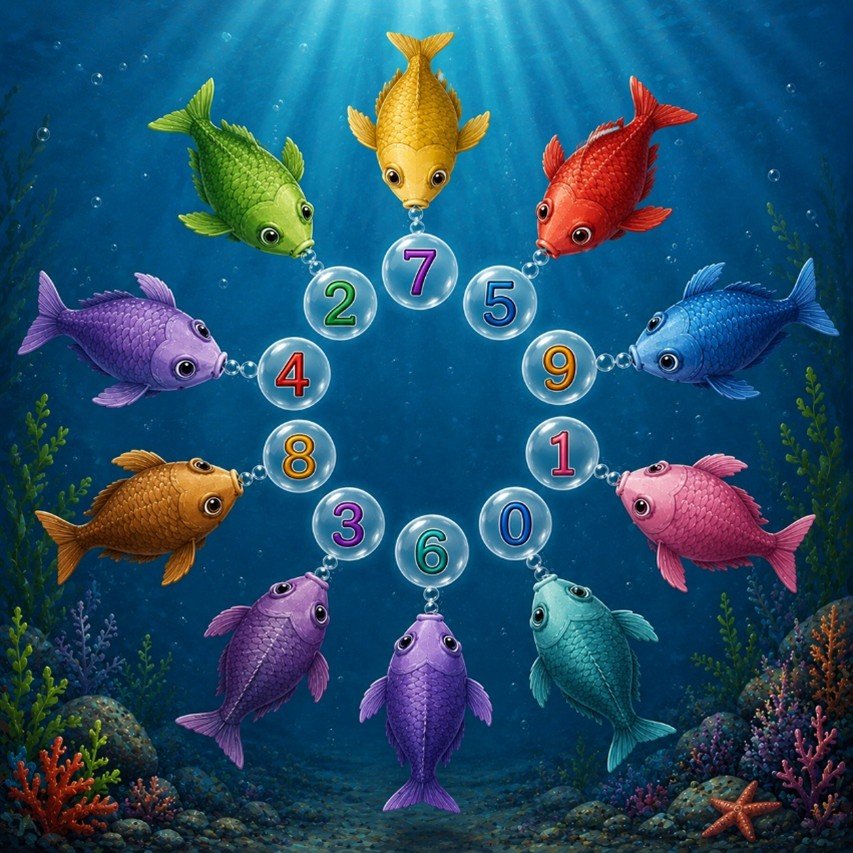
There under my net was a school of fish, of a kind I have never caught before; nay, never seen before! Allow me to describe a peculiar feature of these fish. First, I saw ten fish forming a circle. Each fish blew out a bubble, and lo, the ten bubbles had digits 0 through 9 imprinted on them. They revolved around the circle for a while. Then they gulped in their bubbles, swam around in harmony as if in a dance, and, when they came to rest again around the circle, they blew out their bubble. They had changed their positions around the circle because the digits were in a different order! Then again, they gulped in their bubbles, swam and danced joyfully, and when they came to rest around the circle, they blew out their bubbles. Lo, they were arranged in yet another order!! This went on and on for a long, long time. You might be wondering, how long could this go on? How many distinct orders are there?
Ready or not, here comes a math lesson. Any fish can be in the north position, giving us 10 choices. Then, to its left can be any of the remaining 9 fish, to whose left can be any of the 8 remaining fish, etc. That’s a total of 10*9*…*1 = 10! = 3,628,800 distinct arrangements. But when these fish are dancing around the circle without changing their relative positions, they maintain the same arrangement even though the north position is taken by any one of the 10 fish. This means that there are always 10!/10 = 9! = 362,880 distinct circular permutations.
Then the voice in my head spoke again: “Read the numbers in pairs, always moving clockwise.” When the fish were in natural order (0, 1, 2, …, 9), I read the ten two-digit numbers 01, 12, 23, 34, 45, 56, 67, 78, 89, 90. When the fish were in a different order (3, 5, 8, 2, 0, 1, 7, 9, 4, 6), I read the new set of ten two-digit numbers 35, 58, 82, 20, 01, 17, 79, 94, 46, 63. My mathematician brain immediately added the ten two-digit numbers every time the fish formed a new arrangement, and lo, the sum was always the same! Please try it for other random permutations. What is that constant sum?
Surprising, huh? Once the secret is discovered, the phenomenon loses some of its mystery. But then the voice spoke again, proposing a harder challenge: “How about you multiply the ten two-digit numbers?” I knew I could not trust my small brain to multiply so many numbers, so I pulled out my pocket calculator and jotted down the products. They were huge numbers. So huge that they had to be written in scientific notation! First, the natural arrangement gave the product 9.89898e+14, and then the other arrangement mentioned above yielded a product 1.217985e+15. As the arrangements changed, so did the product, it seemed.
The voice spoke a third time: “Which arrangement makes the product the smallest?” I played around with some random permutations, and I invite you to do the same. Those of you who share my appreciation of mathematics might want to fetch a calculator and see what the smallest product is that you can find. Can you find an order whose product is smaller than the natural arrangement?
Since we know there are only 9! cyclic permutations, sooner or later, one of you will find the smallest product! But likely you won’t share it with me, will you? So, as any diligent college student should, I wrote a computer program to do a complete search. Here is the answer: The smallest product 9.274262e+14 is attained by the permutation (1, 2, 4, 6, 8, 9, 7, 5, 3, 0).
The discoveries so far are interesting but not impressive. A complete search, when efficiently doable, is guaranteed to solve any problem. It may settle a dispute, but it is not appealing to a mathematician, who craves logical proof with few computations. What is that desirable truth? As I tried to fathom it, lo, the school of fish grew larger in numbers — 12, 24, 60, 100, 153, …. As if the voice was speaking again, declaring a new problem. I quickly jotted it down.
PROBLEM: For an arbitrary integer n, which cyclic permutation of digits 0, 1, 2, …, (n-1) produces the smallest (or the second smallest) product of all n two-digit numbers in base n formed by joining each pair of digits read clockwise?
Locating the school of fish with distinct digits, reading the two-digit numbers, posing the mathematical operation of multiplication, identifying the cyclic permutation that minimizes the product, and generalizing the problem to any integer n — I can’t take credit for any of these concepts. My computer could not conduct a complete search beyond 13. A mathematical proof was necessary, but I am only a poor statistician, not trained to solve such problems of Number Theory!
Yet, the solution came to me piece by piece. As a scribe, I diligently wrote down the long mathematical proof whose twists and turns I could not anticipate. Effectively, it felt like I was reading someone else’s work. That someone has surrounded the entire school of fish securely in love. I just collaborated in hauling the catch.
Professional mathematicians have judged the accuracy of the result and published it in Resonance—Journal of Science Education, 30(11). Curious readers may access it for free from https://www.ias.ac.in/article/fulltext/reso/030/11/1425-1444. Unfortunately, it bears only my name as the author. Therefore, I am writing this true fish story for readers who know where the true credit belongs.
About the Author
Jyoti Sarkar

Jyoti Sarkar attends FMC of Indianapolis and works at Indiana University Indianapolis, in the Department of Mathematical Sciences. Born and brought up in Calcutta, India, he studied at St. Lawrence High School run by the Jesuits, the Indian Statistical Institute Kolkata, and the University of Michigan, Ann Arbor. He has been happily settled in Indianapolis since 1991; and he was joined by his wife in 2000 and son in 2004. He is a lifelong learner of reading, ‘riting, ‘rithmetic, and of late a freeware called R. Contact: jsarkar@iu.edu.
